
A technical primer on the AI systems learning physics instead of just patterns NVIDIA Cosmos:...
What the biggest AI announcement at CES 2026 means for physical industries
Physical AI Gets Its Platform
With so many announcements at CES, Jensen Huang made a prediction that many may have missed: "The ChatGPT moment for robotics is coming."
He was not being hyperbolic. He was announcing NVIDIA Cosmos, an open platform for building world foundation models (WFMs). And within weeks, the adoption list read like a who's who of physical AI: Uber, Figure AI, Agility, Waabi, XPENG, and over a dozen other robotics and autonomous vehicle companies.
If you have been tracking AI through the lens of chatbots and content generation, you may have missed this shift. World foundation models represent the next infrastructure layer for AI, and they explain why your 3D data assets may be more strategically valuable than you realized.
The 30-Second Explanation
Large language models learn by predicting the next word. They are trained on text and they get remarkably good at pattern completion.
World foundation models learn by predicting what happens next in physical space. Given a scene and an action, what changes? If this robot arm moves left, what does it hit? If this vehicle brakes now, where does it stop?
This is the missing piece for physical AI. You can train an LLM by feeding it the internet. You cannot train a warehouse robot by letting it crash into shelves for six months. World foundation models give robots and autonomous vehicles a safe place to fail: millions of simulated scenarios instead of expensive, dangerous real-world trials.
For a deeper technical explanation, see "What Are World Foundation Models?"
The NVIDIA Flywheel Strategy
Cosmos is available under an open license. Developers can download the models, fine-tune them, and build commercial products on top of them.
That is not charity. It is a data flywheel strategy. By giving away the models, NVIDIA ensures every robotics company in the world uses OpenUSD as their data standard and NVIDIA tokenizers as their processing layer. This makes NVIDIA the toll booth for all physical AI data, regardless of who builds the end application.
The constraint on physical AI development is not compute (NVIDIA sells that). It is data. Specifically, it is 3D spatial data, the environments where these models learn how the world behaves.
The processing bottleneck is solved. NVIDIA's new Rubin platform has effectively commoditized this scale, processing 20 million hours of video in less than a week. A task that would have taken years just a few generations ago. What remains scarce is quality training environments.
The processing bottleneck is solved. What remains scarce is quality training environments.
Running Cosmos on AWS
AWS has already published production-ready architectures for deploying Cosmos world foundation models. Two options are available:
Real-time inference: NVIDIA NIM microservices on Amazon EKS for low-latency, interactive applications.
Batch inference: Containerized models on AWS Batch for high-throughput, offline workloads like synthetic data generation.
This matters because it means WFM deployment is not limited to organizations with their own GPU clusters. The infrastructure patterns are documented, the integration points are defined, and the path from experimentation to production is clearer than it was six months ago.
(See: https://aws.amazon.com/blogs/hpc/running-nvidia-cosmos-world-foundation-models-on-aws/)
Who Is Already Building on This
The adoption list reads like a who's who of physical AI: Figure AI, Agility, 1X, and XPENG on humanoid robots. Waabi, Wayve, and Foretellix on autonomous vehicles. Agile Robots, Skild AI, and Neura Robotics on industrial automation.
The signal that this has moved beyond research: on January 29, Mercedes-Benz launched its first premium robotaxi service on the Uber network, powered by NVIDIA's Alpamayo stack built on Cosmos. Uber CEO Dara Khosrowshahi: "By working with NVIDIA, we are confident that we can help supercharge the timeline for safe and scalable autonomous driving solutions."
NVIDIA is not alone. Google DeepMind opened Project Genie to AI Ultra subscribers the same week. The differentiation is emerging: Genie 3 excels at dreaming up new worlds from text, while Cosmos Transfer 2.5 maintains strict physical consistency for industrial applications. Google is building for creative exploration; NVIDIA is building the bridge for industries that need world-to-world translation they can trust.
The Four Use Cases
At CES, NVIDIA highlighted four ways physical AI developers are using Cosmos:
1. Video Search and Understanding
Finding specific training scenarios from massive video datasets. Snowy road conditions. Warehouse congestion. Sensor edge cases. Instead of manually labeling petabytes of footage, developers can search for the scenarios they need.
2. Synthetic Data Generation
Creating photoreal training videos from controlled 3D scenarios built in NVIDIA Omniverse. The 3D environment provides the physics; Cosmos generates the realistic sensor data.
3. Model Development and Evaluation
Building custom models on top of the foundation, using Cosmos for reinforcement learning, and testing how models perform in specific simulated scenarios before real-world deployment.
4. "Multiverse" Simulation
Generating every possible future outcome an AI model could take, then selecting the optimal path. This is how autonomous systems can evaluate thousands of decisions before committing to one.
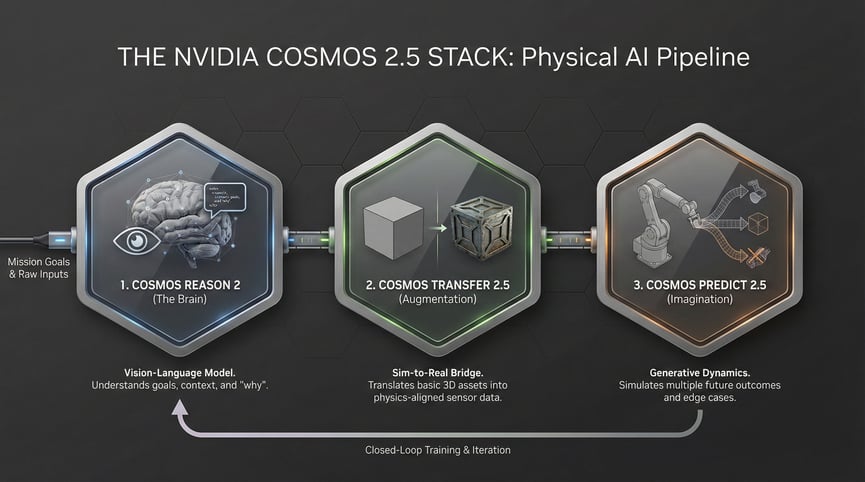
The Cosmos 2.5 Stack
The platform now consists of three specialized models that work as a pipeline:
Step 1: Cosmos Reason 2 understands the goal. This vision-language model interprets what the robot needs to learn and why.
Step 2: Cosmos Transfer 2.5 converts your 3D assets into usable training data. It translates simple inputs (maps, depth data, CAD models) into physics-aligned video.
Step 3: Cosmos Predict 2.5 generates the scenarios your models learn from. It creates photoreal video and sensor data from the conditions Transfer provides.
The result: a complete pipeline from business goal to synthetic training data, with your existing 3D assets as the input.
What This Looks Like in Practice
Agility, the company behind the Digit humanoid robot, explains why this matters:
"Data scarcity and variability are key challenges to successful learning in robot environments. Cosmos' text-, image- and video-to-world capabilities allow us to generate and augment photorealistic scenarios for a variety of tasks that we can use to train models without needing as much expensive, real-world data capture."
Translation: If you have 3D models of your facilities, you can train robots without destroying your facilities.
The Digital-First Factory Pattern
A digital-first factory pairs a physical manufacturing system with a continuously updated digital twin driven by a domain-specific world model. Real-world sensors stream state, events, and anomalies into the digital environment, where the world model simulates system dynamics, evaluates alternative actions, and predicts downstream effects before anything is executed physically.
Actuation is introduced progressively: first as advisory signals, then as constrained or supervised control, with traditional safety systems and human oversight enforcing hard limits. This closed-loop setup allows behavior to be understood, tuned, and stress-tested in simulation while remaining grounded in real data.
BMW Group's partnership with NVIDIA demonstrates this pattern at production scale. Using NVIDIA Omniverse, BMW built a digital-first approach to factory planning and operations, enabling virtual validation before physical implementation. The result: faster iteration, lower risk, and tighter alignment between model predictions and physical outcomes. (See: https://www.nvidia.com/en-us/case-studies/bmw-group-develop/)
The Data Moat
Here is the strategic read:
Your 3D data just became more valuable. Digital twins, simulation environments, spatial datasets: these are not just documentation anymore. They are potential training data for the next generation of AI systems.
The build-vs-buy calculus shifted. Open foundation models mean you do not need NVIDIA-scale resources to experiment with physical AI. You need domain expertise and domain data. The models are commoditizing; the environments are not.
The bottleneck moved. The question has shifted from "How do we use AI?" to "Do we own the 3D environments required to train it?" In 2026, your simulation readiness is your competitive readiness.
What This Means for 2026
Jensen Huang's "ChatGPT moment for robotics" prediction is not hype. It is a statement about infrastructure maturity.
The models are open. The ecosystem is forming (Uber's involvement signals mainstream commercial interest). The processing constraint is solved. The data constraint is not.
2025 was the year everyone talked about AI agents. 2026 is shaping up to be the year we figure out how to teach them physics. And that requires understanding, and owning, the 3D environments where physics gets learned.
How 4D Pipeline Can Help
Physical AI development requires 3D environments that can generate realistic synthetic training data. With over 14 years of cross-platform graphics engineering experience, our team can help you bridge the gap between your existing digital assets and simulation-ready infrastructure.
We have delivered pipelines for major brands across industrial visualization, product configuration, and real-time 3D applications. We understand the difference between "good enough for rendering" and "good enough for physics simulation," and we can help you evaluate where your current assets stand and what it would take to make them WFM-ready.
Whether your goal is to prepare facilities for robotics deployment, build synthetic data generation workflows, or connect your 3D pipeline to AWS and Omniverse infrastructure, we can help you move from strategy to implementation.
Already have a project in mind? Click here to schedule a consultation