
Three PI Apparel events. Five critical insights. One clear message: The future of fashion is...
A conversation with Holger Schmidt, Director of Client Services at 4D Pipeline, and Safir Bellali, Strategic Advisor in Digital Product Creation (DPC) and Digital Innovation, 3DRC Education Chair, and design faculty at Art Center and USC
In Part 1, we explored how students are learning design differently, why clarity is becoming the defining skill, and what open standards mean for the next generation of creators. Now we turn to the harder questions: if the tools are no longer the bottleneck, what is? If students never learned the old way, do companies still need the old roles? And what does that mean for the future of design interfaces?
The Articulation Advantage
When design students struggle with AI tools, the problem is rarely technical. It's clarity.
Derek Cicero: Safir, when design students come to you struggling with AI tools, what's usually the problem? Is it technical skills, or something else?
Safir Bellali: I think it comes down to clarity. A lot of the times when I see a design project that is failing, it's because the design intent and the clarity in the idea and the desired outcome is not there. AI is not going to work with that. If you're not crystal clear about what it is that you're doing, it'll serve you a bunch of stuff, but it is going to be really hard for you to justify why it looks like that, why it behaves like that, if you don't have that clarity.
There's also a component we shouldn't underestimate: the language barrier. Someone's ability to verbalize what they're trying to do can be a hurdle. If you're not really good at communicating very specifically how you want things, yes, eventually you might get there, but it's going to take longer. It might lead you to different outcomes and chances are that you might be pulled away from what you originally wanted to do.
This is why I think now more than ever, creative control and creative intent is going to be much more important. The tools can do a lot. The tools can take you in a thousand different directions. If you don't remain in control of the process and of the desired outcome, the tool is going to design for you. And that's not design. That's just creating stuff and showcasing it to your friends because it looks cool.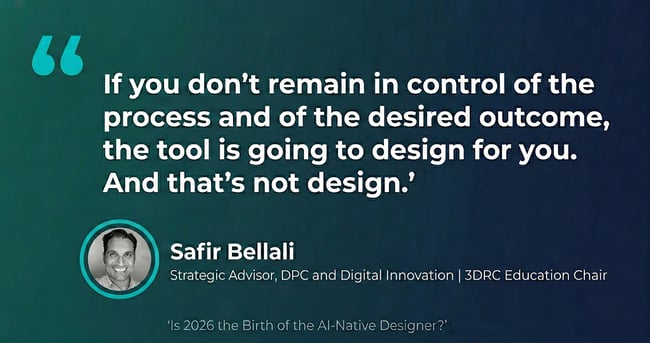
Holger Schmidt: That's actually a perspective I have not had before. Thanks, Safir. It's interesting because that means people in the future who can express themselves very well, who can externalize their thoughts, verbalize things, that is actually a skill that will become way more important.
Derek: Which flips what we traditionally looked for when hiring. The job posting said "5 years CLO experience" or "expert in Rhino." But if the students coming up never learned those tools the old way, and they're getting comparable results through articulation and iteration, maybe the job description needs to change.
Holger: Exactly. And it's not just about individual skills. It's about how teams are structured. When we work with clients nowadays, we're seeing questions come up about whether they need the same handoff points, the same specialists as today. If someone can go from concept to prototype without switching tools or switching people, do you still need a "3D artist" as a separate role? Maybe that becomes part of what every designer does.
The Interface We Haven't Built Yet
Right now, designers toggle between two worlds: clicking through menus and typing prompts into AI. The interface that truly unifies them will reshape how we create.
Derek: I haven't seen a huge change yet in how interfaces work. It's the classic GUI with text boxes bolted on. There are times when I want to click on a pixel and grab something and copy and paste it. Some things are easier to do manually than verbally. What are you seeing in the UX/UI space?
Safir: There are a number of things that don't really make sense in the way we do things today. We design 3D objects, 3D assemblies by pecking on a keyboard and searching around menus, clicking with a mouse. That makes absolutely no sense. You're building 3D objects. The natural way of doing this is to be in a 3D environment and then shaping things and building things.
At the same time, you have this recent development where you have conversational interfaces where you explain what you're trying to do and you go through different iterations. That is also not perfect because imagine if everyone in an office space starts talking to their computers. There's got to be something more practical at scale.
I don't think we've seen the perfect UI and the perfect user experience yet. I just hope someone is taking advantage of the incredible affordances of AI and spatial computing to create something that feels more intuitive, that feels more natural, yet is powerful.
I'm teaching a graduate-level course that includes students from the Marshall school of business, students who have never designed anything or never touched 3D. I introduced them to 3D using a program called Shaper 3D. I really like the way the user interacts with the object. It's not spatial computing, you're not in VR, but the way you actually do things feels very natural.
I hope large software companies are thinking about this and are considering the opportunities to create user interfaces for Digital Content Creation tools (DCCs) that are a combination of these affordances. I think there's a lot to be gained from that.
When Students Never Learned the Old Way
Students coming out of school don't separate "AI tasks" from "3D tasks." They just think about making the thing.
Derek: Do students see AI and traditional 3D tools as separate things, or do they see them working together?
Safir: I think they're starting to understand the power of combining the two. Using AI to overcome certain hurdles in the use of traditional tools, for sure. Until then, you would have to look at tutorials, look at videos, ask questions. Now you have the ability to really work through things.
But here's what's interesting: they don't have the same mental separation that people in industry have. They didn't spend ten years mastering one toolset and then have to learn another. They're picking up whatever helps them express their idea. They're seeing how, by leveraging the best of both worlds and understanding what one set of tools can do that the other one doesn't, and finding ways to amplify the impact by combining and creating workflows that integrate both. That's the exploration that's happening right now that I'm really excited about.
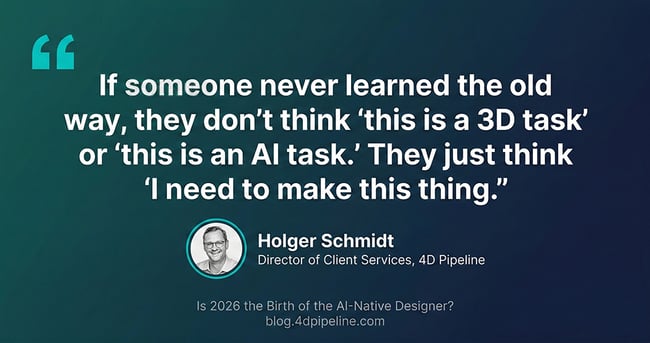
Holger: And that's where the role question gets interesting. If someone never learned the old way, they don't think "this is a 3D task" or "this is an AI task." They just think "I need to make this thing." The specialization we built into and around our organizations, those categories might not make sense any longer. They become fluid, moving between tools and approaches based on what the project needs.
Derek: So we're not just talking about new tools. We might be in the middle of a fundamental shift in how we think about roles in a company. It reminds me of what happened when desktop publishing came along. Suddenly you didn't need a typesetter, a layout person, and a paste-up artist. One person could do what three people did, not because the work disappeared, but because the tools collapsed those steps. Are we seeing something similar now?
Holger: I think so. The work itself doesn't go away. It's that "designer" might absorb capabilities that used to require specialists. The categories we built our organizations around might need to be redrawn.
What Limits Us Now
Once tools are no longer the bottleneck, we have to answer a harder question: what's actually worth making?
Derek: We're having this conversation in January 2026. If we get back together in January 2027, what will have changed?
Safir: Once the tools are completely rethought with the help of AI, once you can build things in 3D by just talking through the process, the go-to-market process is not necessarily going to be what limits us as a society.
What's going to limit us is our ability to really understand what it is that our society needs. All the industries are there because they are offering solutions and products that fit a specific expectation, that fulfill a need, that perform a certain function. I hope that in the near future, with this ability to do more, build better products, build better experiences faster and much more powerfully, our ability to really understand what is worth doing and what is not, and where our time and effort and resources should be invested, is going to be developed and put at the highest level. Because ultimately that's what's going to matter.
Holger: I still remember walking into Adidas and seeing those big whiteboards, stickers of textiles, pictures, all this ideation happening. You could feel the creative process. With generative AI, you get to the point where you can just throw your thoughts and imagination in. You don't have to click buttons or draw lines. You naturally say, "Hey, I want this," and it appears.
What won't go away is the expertise needed to evaluate if something works, if you're making the right decisions. Your job doesn't go away. It transforms. You need to be able to use the tools to make your job different.
Driving the System, Not Being Driven
The students Safir is teaching are learning craftsmanship. Just in a different order.
Holger: My main takeaway from this conversation, it's about being precise, really knowing what you want, driving the system, not being driven by the AI. Because it's very easy to be a spectator. You need to be in control. You need to understand what you want to achieve. And then it will help you tremendously. But not if you ask the AI, "Hey, what should I do today?"
Safir: Exactly. As a designer, you have to develop an emotional connection with the thing you're designing. If that connection happens just through a screen and through digital tools, no matter how good these tools are, it's never going to be the same as if you really shape the product.
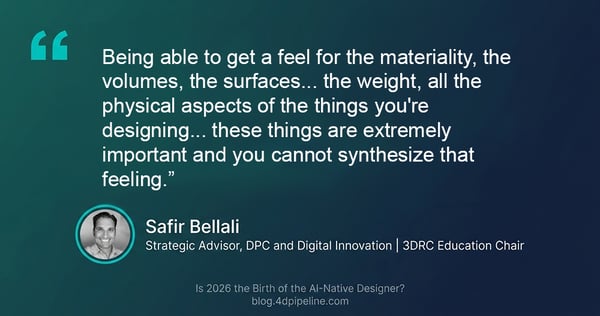
Being able to get a feel for the materiality, the volumes, the surfaces, touch them, the weight, all the physical aspects of the things you're designing, the hand of a material when you're designing a garment, how this garment actually drapes, how it behaves dynamically when you move. All these things are extremely important and you cannot synthesize that feeling.
Holger: You still need to have the craftsmanship to say and to judge if what you see is correct. The AI will not tell you because it cannot. So you still need to know how the drape should look like, how your vision of that product should look in motion.
Derek: So the students Safir is teaching are learning that craftsmanship. Just in a different order. They're starting with intent and working backward to technique, instead of starting with technique and hoping to develop intent.
Maybe that's the real shift. Not the tools. The sequence.
Meet Us at PI Stride USA 2026
Holger Schmidt and Tyler Worden will be at PI Stride in Portland, March 9-10, 2026. If you'd like to continue this conversation or discuss how these ideas apply to your digital product creation challenges, reach out before the event.
Connect:
- Holger Schmidt: LinkedIn
- Tyler Worden: LinkedIn
- Safir Bellali: LinkedIn